Unpacking HMIS
Aubry Vonck • June 22, 2021
Unpacking HMIS (Homeless Management Information System)
In 2020, more than 45,000 people accessed some type of homeless or prevention service in Harris, Fort Bend, and Montgomery counties. Each of these 45,000 people have a unique story. Because of how robust our local homeless response system is and how many clients we serve, it is essential that we have a database that aids us in collecting relevant data on our clients in order to best serve them.
What is HMIS?
A Homeless Management Information System (HMIS) is a database used to record and track client-level information on the characteristics and service needs of homeless persons. An HMIS ties together homeless service providers within a community to help create a more coordinated and effective housing and service delivery system.
The U. S. Department of Housing and Urban Development (HUD) and other planners and policymakers at the federal, state and local levels use aggregate HMIS data to obtain better information about the extent and nature of homelessness over time. Specifically, an HMIS can be used to produce an unduplicated count of homeless persons, understand patterns of service use, and measure the effectiveness of homeless programs.
HUD requires all agencies receiving federal funds from the McKinney-Vento HUD Program for use in serving the homeless community to participate in the HMIS. Starting in 2011, Emergency Solutions Grant (ESG) and Supportive Services for Veteran Families (SSVF) providers are also required to participate. Agencies who provide services and/or shelter to the homeless community but who don’t receive federal funding can still apply and get access to use HMIS subject to Coalition review and approval.
Who is responsible for HMIS?
The CoC Program Interim Rule (24 CFR Part 578) assigns responsibility for the HMIS to the CoC. It makes clear the the CoC is ultimately responsible for HMIS, and not the agency that gets the grant because the grant is awarded on behalf of the CoC.
The CoC must designate a single HMIS system for the geographic area and a single eligible applicant as the HMIS lead. The HMIS lead is the only applicant eligible to apply for CoC funds are the HMIS program component. The management of HMIS is delegated to the HMIS lead agency, but the CoC maintains the oversight role. The TX-700 CoC’s (more commonly known as The Way Home) HMIS is staffed at the Coalition for the Homeless. The Coalition’s HMIS staff is responsible for the administration of the HMIS software and providing technical assistance to participating agencies and end-users.
Agencies that participate in The Way Home CoC’s HMIS are referred to as “participating agencies.” Each participating agency needs to follow certain guidelines to help maintain data privacy and accuracy. The guidelines listed in this document do not replace the more formal and legally binding agency agreement that each agency signs before program implementation.
How does HMIS make our system better?
Before 2012, agencies worked in silos and thus were unable to effectively communicate, analyze data, and relay information. Agencies had no way of knowing what services an individual had already received or where they had received it. They could not share case plans or outcomes. Sometimes individuals were receiving services that may not have been the best intervention for them, but it was what was provided at the door on which they happened to have knocked.
The implementation of HMIS was a huge help in breaking down those barriers while still preserving client confidentiality. Our system now provides a community-based approach to assessing and referring people for services, which is all done electronically through the HMIS. When individuals are assessed through Coordinated Assessment, they are put on a waitlist based on vulnerability and prioritized for housing. They are then referred to any organization that fits their needs according to their assessment. This collaboration makes our agencies more effective and our clients more primed to succeed. HMIS Data is reported to HUD to communicate how well the system and its projects are doing.
Having access to HMIS represents a strategic advantage for service providers. The HMIS software we use allows multi-level client data sharing between organizations, as well as client case coordination and electronic referrals. Our locally developed information-sharing model can prevent service duplications and enable collaboration between various homeless service providers, while limiting access to sensitive data. Client privacy is very important to us.
In addition to the standard data collection and reporting functionalities, the HMIS software includes a comprehensive case management module, bed management, performance measurement tools, ad-hoc reporting, software customization options, etc. Lastly, providers already in HMIS are better positioned to apply for future funding opportunities, as many national and local funders now require HMIS participation.
There are currently over 900 active users from around 100 different organizations capturing data in The Way Home Continuum of Care.
What does HMIS tell us? How does it help us better serve our clients?
While much of the work of HMIS is behind the scenes, it truly is the core of our local homeless response system. Every piece of data is essential in order to make data-driven decisions and track how many people have been permanently housed, how many are still experiencing homelessness, and how many we still need to provide services for.
A client’s HMIS record tells their story; each agency that provides services to a given client is another chapter to their story. An example of a “story” for a client experiencing unsheltered homelessness could be some outreach enrollments, some shelter enrollments, and an end result being housed in Rapid Re-housing
or Permanent Supportive Housing.
HMIS Training and the National Human Services & Data Consortium Conference
In April 2021, our HMIS team presented at the National Human Services & Data Consortium Conference. Data System Manager Kelita Beechum and Data System Specialists Agnes Asigbey and Lindsey Grubbs represented the Coalition for the virtual presentation which was attended by nearly 600 individuals.
The presentation focused on improving HMIS training curriculum and delivery. They shared our system’s methods of conducting training. While trainings were completed in-person prior to the pandemic, the team shared how they transitioned to virtual trainings. In the beginning, this required a lot of experimentation, but the team adapted quickly. Platforms used include GoToMeeting, Zoom, and Microsoft Team. The platform used is based on how many people attend and what screen sharing needs are required.
Virtual trainings have actually increased training attendance. These trainings can accommodate more individuals, and it’s more accessible. Because HMIS is so complex and so are our clients, we are grateful for a system that values good data and effective training. These training sessions (more than 10 are offered monthly) cover everything from new user basics to more complex functions and reporting. Click here
to view a calendar of the many HMIS trainings offered.
The Coalition is proud of our HMIS team!

Erol Fetahagic
Director of Analytics & Evaluation

Yvette Fuentes
Analytics & Evaluation Associate

Karen Flores
Analytics & Evaluation Analyst

Kelita Beechum
Data Systems Manager

Lindsey Grubbs
Data Systems Specialist

Agnes Asigbey
Data Systems Specialist
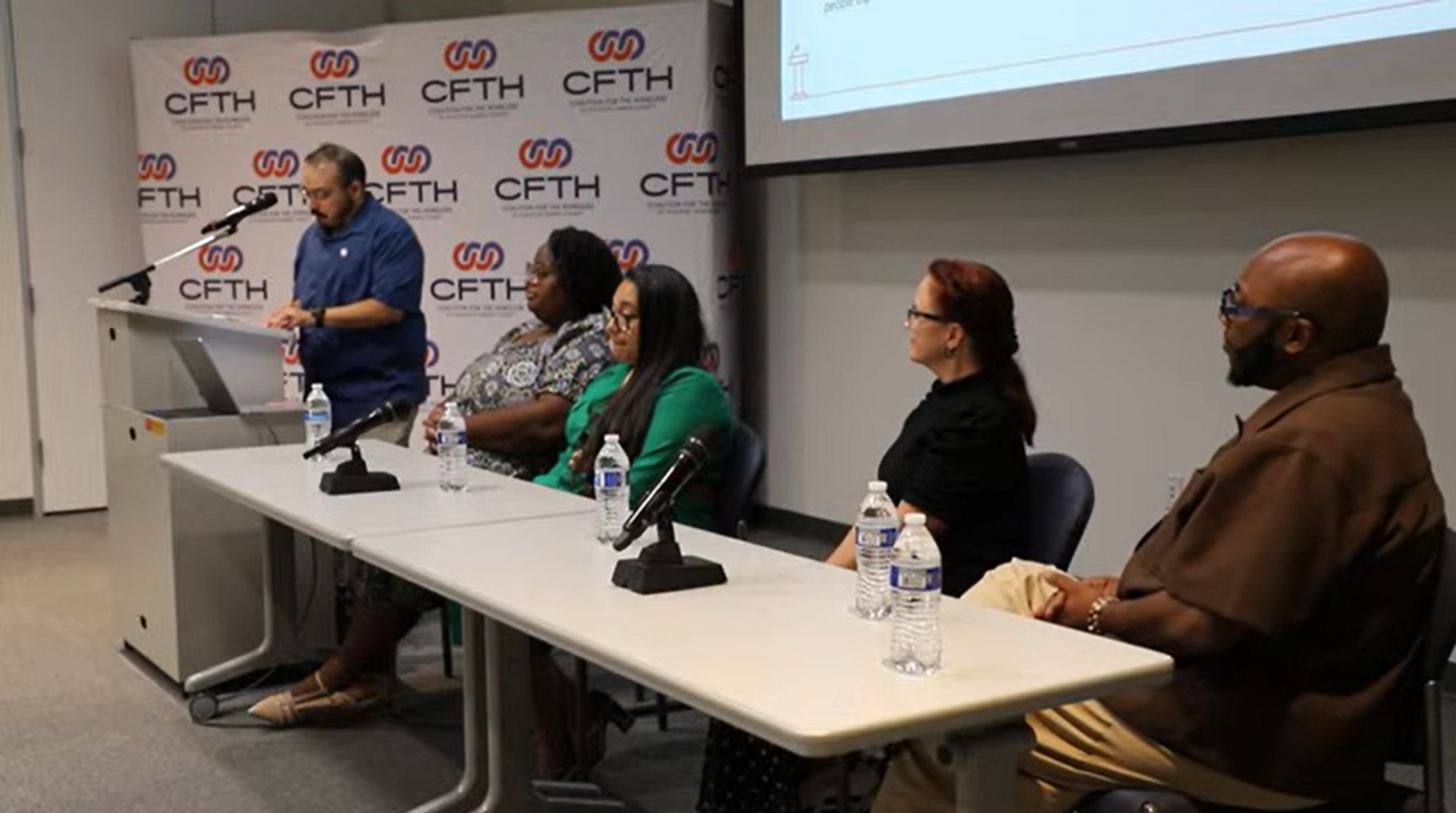
When someone experiences homelessness, the right solution is not always a long-term housing program. Sometimes a person needs help replacing an ID, reconnecting with family, finding an affordable shared home or overcoming another immediate barrier. That idea guided CFTH Presents: Building Better Pathways — Creating Faster Routes to Stability . The Coalition for the Homeless of Houston/Harris County (CFTH) hosted the discussion with leaders who oversee and carry out Rapid Resolutions across The Way Home, the Houston region’s homeless response system.

When most people think about homelessness, they picture someone sleeping outside or staying in a shelter. But homelessness often begins much earlier. A new survey from Rice University's Kinder Institute estimates that more than 140,000 adults across Harris, Fort Bend and Montgomery counties experienced temporary homelessness during the past year. Many of these individuals never slept outside. They stayed with friends or family because they had nowhere else to go, paid for motel rooms when they could, slept in their vehicles or found other temporary ways to get by. For those of us working in Houston's homeless response system, the estimate did not come as a surprise. What stands out is the scale. Our 2026 State of Homelessness report found that nearly 36,000 people interacted with The Way Home, Houston's regional homeless response system, during 2025. The Kinder estimate shows a much larger group of households struggling before they ever reach organizations like ours. Those numbers do not compete with one another. They tell the story of different points along the same continuum. By the time someone decides whether to enter a shelter or sleep outside, opportunities to prevent homelessness have often passed. The homeless response system helps people regain stability after they are in a shelter or on the street. Prevention happens months earlier, while people are still trying to hold on to their housing. Most people do not ask for help at the first sign of trouble. They work extra hours. They borrow money from family. They juggle bills. They hope next month's paycheck will solve this month's problem. Like most of us would, they try to solve the problem themselves. By the time they reach out, they often need far more help than they would have needed just a few months earlier. That is why Houston's prevention network is so important. Organizations like United Way of Greater Houston connect residents with rental assistance, utility assistance, benefits navigation and other resources that help stabilize households before they lose their housing. If you are struggling to keep up with rent, utilities or other essential expenses, do not wait until you have exhausted every option. Reaching out early gives providers more opportunities to help and gives families more options to stay housed. The Kinder research also reinforces another reality facing our region: We need more affordable housing. More than 140,000 adults experienced temporary homelessness in a single year because too many households live one unexpected expense away from losing their housing. That number points to a much larger population searching for homes they can afford long before they need homeless services. Houston's homeless response system continues to produce strong outcomes. More than 2,100 households moved into permanent housing during 2025, and 85% of those who exited homelessness two years ago remain housed today. At the same time, more than 7,100 people slept in shelters or on the street for the first time in 2025. Those numbers show that while our homeless response system continues to help thousands of people regain stability, new households continue to enter homelessness every day. The Kinder research gives Houston something we have not had before: a clearer picture of the households struggling before homelessness becomes visible. The Way Home will always play a critical role in helping people regain stability, but we also need to help more people before they ever need those services. That means strengthening prevention programs, expanding affordable housing and making it easier for people to ask for help early. Houston has repeatedly shown that when our community understands a challenge, it comes together to solve it. This research gives us a better understanding of where the next challenge begins.

Extreme Heat Is America's Deadliest Weather Hazard. Find Trusted Resources to Stay Safe and Help Others.